
By Elton Law Group

When a borrower collapses, the personal guarantee is often the only thing standing between a lender and a total loss. In Fammac Pty Limited v Wright [2026] NSWSC 608, the NSW Supreme Court enforced guarantees worth over $5.1 million (with interest) against a director who ran every escape argument available.
The lenders won, but each defence exposes something lenders should get right before the money goes out. Here are the five lessons.
The Story in 30 Seconds
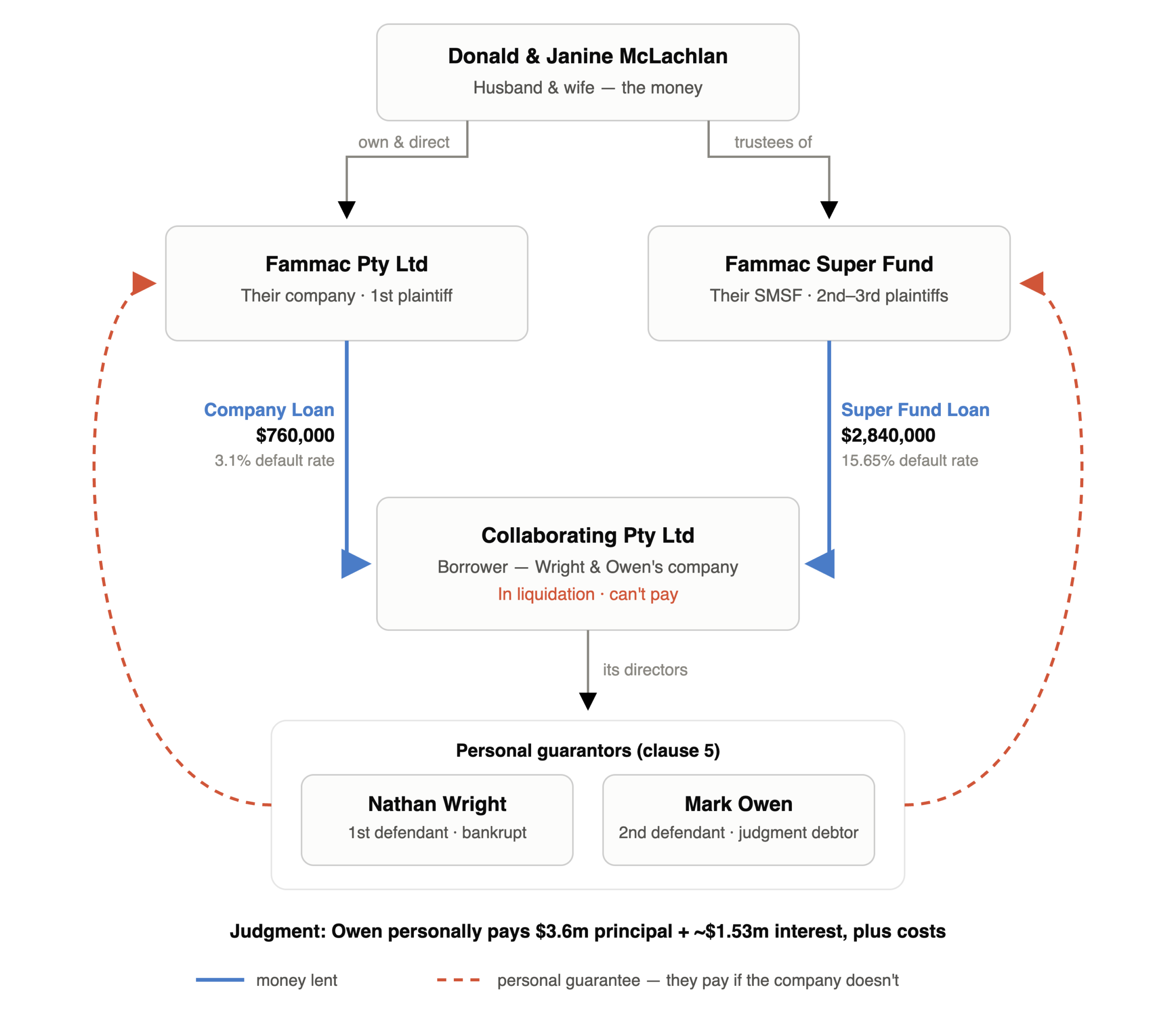
- A husband and wife lent $3.6 million to a company run by two business associates, through their own company ($760k) and their super fund ($2.84m).
- Both directors personally guaranteed the loans, signing via DocuSign next to the word “Guarantor”.
- The borrower stopped paying and went into liquidation. One guarantor went bankrupt. The lenders pursued the other, and won in full.
Lesson 1: Lending from a trust or super fund? Check the deed first
The guarantor’s boldest argument: the super fund wasn’t allowed to lend at all, so the whole deal, guarantee included, was void.
It failed because the McLachlans’ trust deed expressly gave the trustees discretion to invest fund moneys. If your lending vehicle is a trust or SMSF, confirm the deed permits the loan before you advance. The McLachlans could point to the clause. Not every lender can.
Lesson 2: Electronic signing works, but know what you’re signing
The guarantor argued the DocuSign signature couldn’t be proven to be his: there was no security validation, and staff in his office had access to the email address linked to it. The argument went nowhere. Once a signature appears on the document, the apparent signatory bears the onus of proving someone else applied it. He had no evidence, so the signature stood.
Two refinements for lenders:
- This was an agreement, where electronic execution is straightforward. If your document is a deed, signing and witnessing rules differ by jurisdiction, so check them before relying on e-signatures.
- Turn on identity verification in your signing platform. It costs nothing and stops the argument before it starts.
Lesson 3: One signature, two hats? Use separate signing blocks
“I signed as a director, not personally” failed under the High Court’s rule in Toll v Alphapharm: sign a document and you’re bound by it, read or not. And s 110A(5) of the Corporations Act now recognises that one signature can cover multiple capacities if the document makes each capacity clear.
But why litigate it? Give each capacity its own signature block: one as director, one as guarantor. One signatory here signed against a combined “Director & Guarantor” label, and capacity arguments fuelled the defence. Separate blocks kill them.
Lesson 4: Don’t make a court hunt for consideration
A contract is only binding if each side gives something of value in exchange, what lawyers call “consideration”. The guarantor seized on this: he was never paid anything to be guarantor, so, he argued, his promise wasn’t binding. The Court took a broader view. The value in the bargain was what the lenders gave: they kept funding the company and held off enforcement, and the evidence showed they only did so because the guarantees were in place. That exchange was enough to make the promise binding.
But the lenders only proved that through affidavits, years later. Recite the consideration in the document itself (“the Lender continues the facility in consideration of the Guarantors’ obligations”), or execute the guarantee as a properly formalised deed, which needs no consideration at all. One sentence of drafting replaces a contested trial issue.
Lesson 5: Precision in the parties clause is free
The final attack: the loan named the “Fammac Superannuation Fund” as lender, but a fund isn’t a legal person, so, he argued, the McLachlans had no right to sue. The Court applied commercial common sense: a fund acts through its trustees, and the McLachlans were the lender.
Right result, avoidable fight. Name trustees in their trustee capacity (“X and Y as trustees for the Z Fund”), use exact legal names, and include ACNs. The lenders here also let the borrower draft the documents. They won anyway, but control your own paper.
Bottom Line
Even if a defence had landed, the Court indicated the guarantor would have been estopped (legally blocked) from arguing the defence. The idea is simple: you can’t run a relationship on a mutual understanding for years, taking the benefit of loans that only kept flowing because your guarantee stood behind them, and then, when it all goes wrong, reach for a legal technicality that contradicts how both sides actually behaved the whole time. The law holds you to the understanding you let the other side rely on. For lenders, a consistent, documented course of dealing (annual statements, redocumentation, correspondence) builds a safety net under the whole facility.